


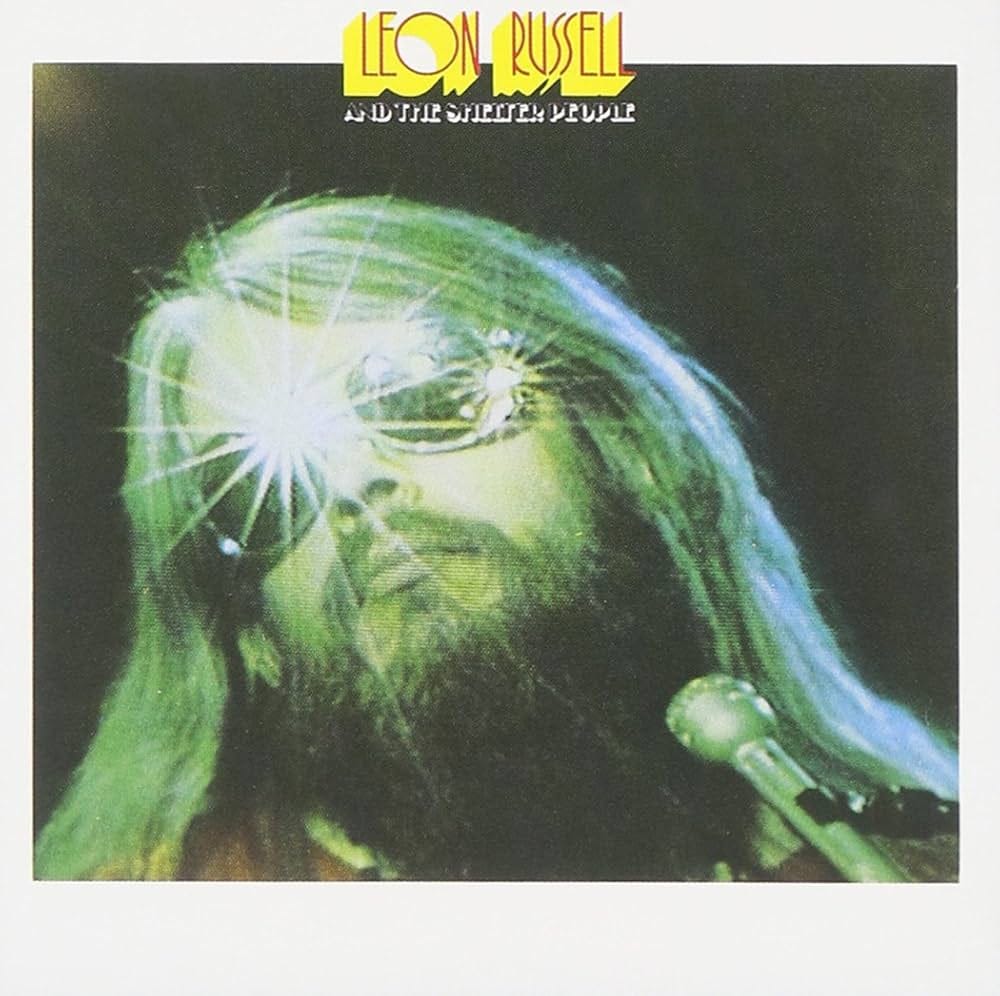
At this point, I have to wonder if some of these records don’t belong to someone else. While it’s true that my brother's limited collection was included (unbeknownst to him) in this acquisition, I can say with almost complete certainty that my parents weren’t into Rush or Iron Maiden. Although at this point, anything goes.
If I work under the presumption that these unusual finds are theirs, I’m left asking myself who these people were. As I mentioned, my father had almost zero interest in music, so I feel these records I am discovering are, safe to say, my mother’s.
This week, it’s Leon Russell and the Shelter People from 1971.
Similar to Little Feat’s Feats Don’t Fail Me Now discovery, I have a hard time picturing my mom sitting around in our basement ripping bong hits listening to these albums, and yet here we are.
By 1971, Leon Russell wasn’t just part of the machinery; he was building his own. Leon Russell and the Shelter People feels like a man stepping out from behind the console and deciding the room should sound like him.
Leon Russell is one of those musicians you've definitely heard of but maybe don’t know. A prolific writer, you’ve more than likely heard one of the songs he’s written. He never wrote solely for his own voice; he left room for interpretation. A Leon Russell song sounds like him, but it also sounds like whoever covered it, which is a harder trick than it looks. That may be why there are over 20 versions of his song “This Masquerade” (off of Carney), with George Benson’s version being the best-known.
This record appears to have been recorded in fits and starts, because it lists four different groups as background musicians. It’s less a band and more like a loose collective; there’s The Shelter People, the Tulsa Tops, Muscle Shoals Swampers, and Friends in England. That being said, there is a cohesive fluidity to the album that belies the varied and seemingly complicated background groups.
Russell has a unique ability to compose his songs from the piano outward, which is to say that his songs feel played versus constructed.
The reflective and soulful “Stranger in a Strange Land” opens the album. There is a gospel sense of drama here as he sings about feeling out of place and the questioning of one’s life, “How many miles will it take to see the sun and how many years until it’s done”, but is never self-pitying. Russell isn’t asking for understanding; he’s documenting distance.
Judging by the title alone, “Of Thee I Sing,” you might think it’s a gospel song. And I suppose it is of sorts, as it was written in the aftermath of the Kent State shootings. Musically, the song begins with Russell’s energetic piano a la Jerry Lee Lewis. The music builds with gospel backing vocals and a tight rhythm section. Another thrilling build takes the song’s climax straight to the pulpit. The music pauses. The preacher preaches, and on the last note, everybody testifies.
This is the “Tulsa Sound” with muscle. Gospel, country, rock, and a little bit of preacher’s dust all kicked into the same corner. It’s loose, but not sloppy. There’s a difference. Russell understood that feel matters more than precision, even if he had the chops for both.
By the time you get to his cover of Bob Dylan’s “A Hard Rains Gonna Fall”, he’s not covering Bob Dylan so much as reclaiming the song, turning it into something heavier, almost apocalyptic.
Side two cracks open with “The Ballad of Mad Dogs and Englishmen,” a song from the documentary Joe Cocker: Mad Dogs and Englishmen. Russell's sparse piano and string arrangement reads almost as a rationalization for the confusion and mayhem that was documented in the film. This one doesn’t quite land. It feels more like an obligation than a song.
Russell covers one more Dylan song here with “It Takes A Lot To Laugh, It Takes A Train To Make You Cry”. This is the type of song that typifies the “Tulsa Sound.” It’s loose, has a groove, and a lack of polish that makes you feel like you’re a fly on the wall.
That feel is what you get from this album. You can almost get a contact high listening to it. Leon Russell and the Shelter People reminds me of what I like about albums from this era: the imperfection. This was a popular and successful record, but it isn’t perfect. So much popular music today is perfect; sure, imperfection is found on the fringes, but by and large, perfection is the name of the game. There was a time not too long ago when groove was the name of the game and perfection was secondary.
The more I dig into these records, the more I realize I'm not just finding great music. I'm finding a version of my mother I never knew existed. At this point, I'm not sure which discovery is more surprising.
Leon is a songwriter's songwriter.
Leon is the King!