


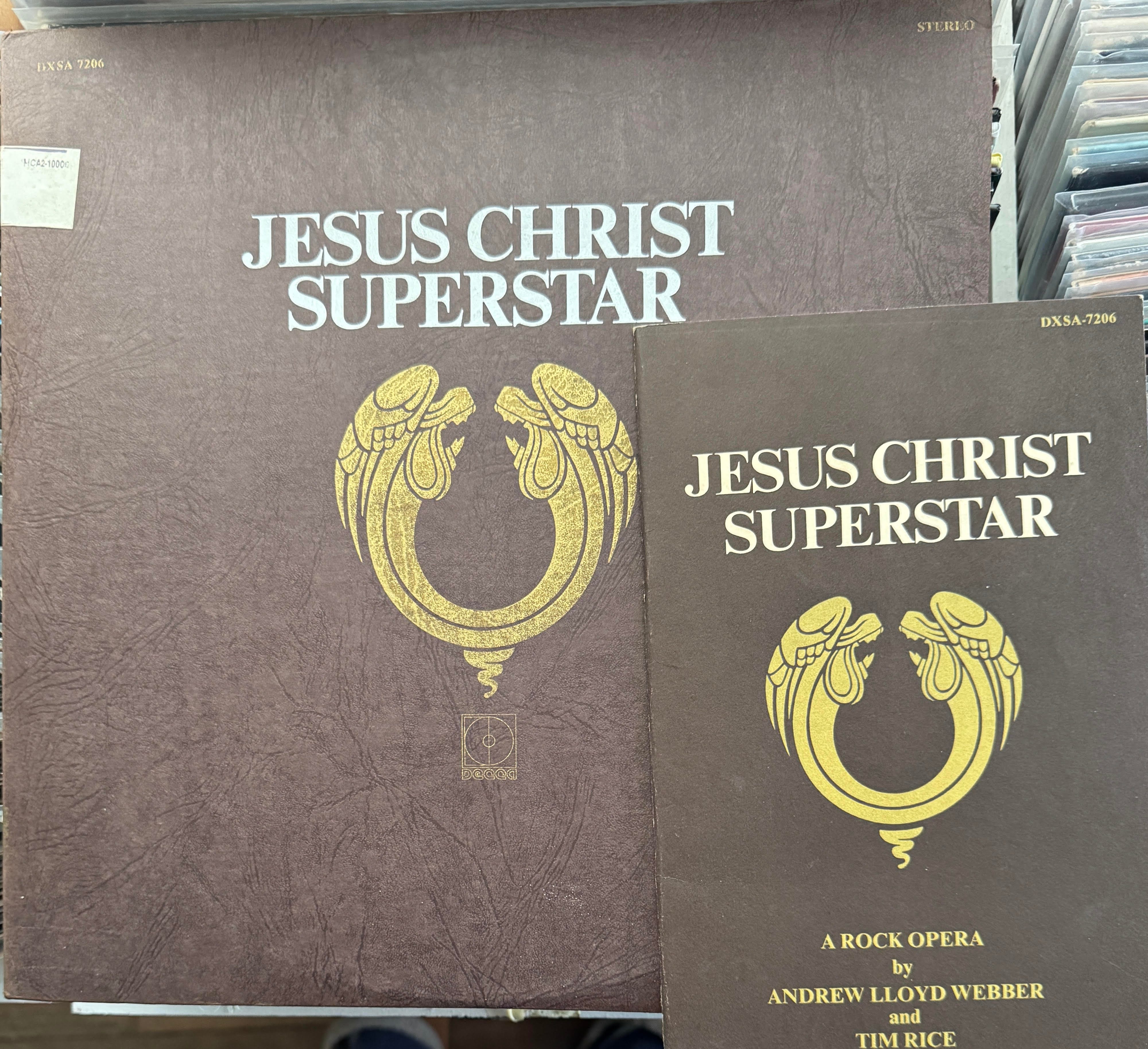
I’m still rifling through my parents’ record collection and realizing my mother (it would’ve absolutely been her) didn’t have such awful taste. Sure, there are loads of duds, but there are enough diamonds in the rough to make me wish she were still here so I could ask her questions.
I stumbled on the original rock opera Jesus Christ Superstar from 1970. Like its predecessor, the year before, The Who’s Tommy, it was an album before it became a theatrical production.
The record itself is in miraculous shape (complete with libretto) for an album that’s 56 years old. If I’m honest, like the Little Feat album, it initially felt a little out of place, but then I thought more about it.
While I was too young to recall it, it seems as though Christianity and spirituality were having a moment in the late 60s and early 70s.
We were a church-going family. But we went to a straight-up Lutheran church, not one that mixed experimentation, Eastern religion, or celebrated a revival of Jesus as a counterculture figure. I’m learning that my mom had diverse musical tastes, but diversity in religion seemed anathema to what I knew of her. Perhaps I was wrong.
Now, I don’t have a real fondness for musical theater (and, no, I have not seen Hamilton). I don’t hate it, and would prefer showtunes over the sounds of my neighbor’s leaf blower, but I can’t say it’s ever a go-to genre for me. But for my parents, or at least my mother, musical theater was. Their record collection contains an alarming number of cast recordings. For me, seeing a show is a wildly different experience from listening to the soundtrack, and I don’t mind watching musical theater.
The two names I recognized from this recording were Ian Gillan and Yvonne Elliman. Gillan, the lead singer of Deep Purple, sings the part of Jesus. I can’t help but wonder if there isn’t some tongue-in-cheek casting of the lead singer of a rock band as Jesus. I wonder how David Lee Roth would fare in the same role. Elliman, probably most known for her contribution to the Saturday Night Fever soundtrack, “If I Can’t Have You", sings the part of Mary Magdalene.
Also of note is Murray Head, who sang the part of Judas. You may recall Head from his 1984 hit single “One Night in Bangkok”.
Jesus Christ Superstar is one of four Andrew Lloyd Webber and Tim Rice collaborations (I honestly thought there were more). Their third after The Likes of Us and Joseph and the Amazing Technicolor Dreamcoat, and the one before Evita. That’s not too bad a CV.
The premise of this musical is based on the Passion narrative in the New Testament. In other words, the events of the final week of Jesus’s life. I’m going to guess that if you’re reading this, you are at least moderately familiar with how that all played out.
The album spun off two hit singles, “Superstar” by Murray Head and “I Don’t Know How to Love Him” by Yvonne Elliman. The album itself hit number one on the Billboard album charts and stayed there for three weeks.
If you know the story, the album plays like a stage production in your head. Each song unfolds like a scene, with characters entering and exiting in sequence. By the time the record reaches the climax, you’re not just listening, you’re watching the entire drama play out.
Jesus Christ Superstar plays like a political tragedy, focusing less on divinity and more on the unstable power struggle between Jesus, the Roman authorities, and the religious establishment.
The anxiety expressed by Judas, it’s pretty fair to say, reflects fear about mass movements and megalomaniacs. It seems these concerns resonated strongly in the late 1960s and early 1970s, when protest movements and revolutionary rhetoric were more common.
Jesus Christ Superstar deliberately strips the story of overt supernatural elements, which works in the album's favor and enhances its accessibility. Miracles are mentioned but not emphasized, and the Resurrection is absent entirely. Instead, the focus rests on emotional conflict, Judas’ doubt, Mary Magdalene’s affection, and Jesus’ own anxiety in the Garden of Gethsemane.
And if you were the type who'd walked away from the church but hadn't entirely walked away from the questions, that probably resonated.
As I continue to sift through this collection, I am discovering so many records that feel like a small correction to what I thought I knew about my mother.
By pairing a biblical narrative with electric guitars, Webber and Rice took the New Testament and ran it through a Marshall stack.
There are more modern recordings of Jesus Christ Superstar, and honestly, you’re probably better off with one of those. This original version isn’t bad; it just shows its age.
That said, the whole project was about making an old story feel immediate. Urgent. Dangerous, even. And for one specific moment in history, the original Jesus Christ Superstar did that.
That moment has passed. What’s left is a very good album that sounds exactly like 1970 trying to ask eternal questions.
I had a copy of this--got it when I was 15. Maybe I still have it. It meant so much then, even though i was never religious. Loved Murray head especially.
A fellow Lutheran! Hail, Reformers! I grew up in the LC-Missouri Synod. What was your Synod (there were/are about 3 or 4 different ones)? In fact, it was going to the LCMS-connected Concordia U in Irvine, CA (Orange County) that I went to in the mid-'80s (the career turn that took me out of the record biz....why my '80s musical knowledge is thin, at best)! Going to college, then starting a 6-year career as a full-time, certified DCE (Director of Christian Ed)/youth minister at two SoCal LCMS congregations!