


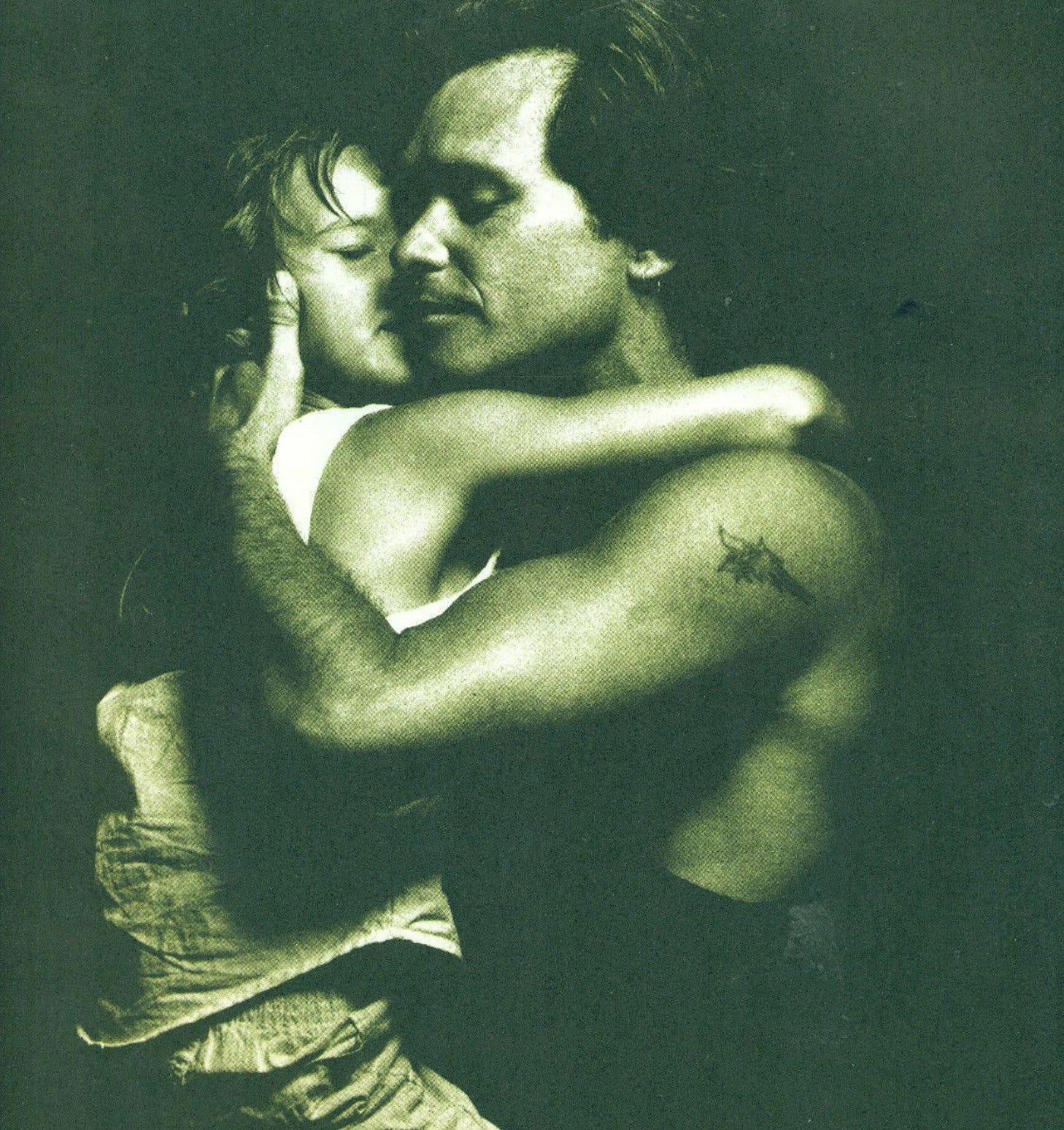
By the time Big Daddy dropped in 1989, John Mellencamp had been chronicling the Reagan era long enough to know that nothing, the economy, the rhetoric, or ordinary life ever ended as neatly as politicians promise. Where earlier records caught tension or aftermath, Big Daddy watches the dust settle into the everyday.
Ronald Reagan had been out of office for five months when Big Daddy arrived in May 1989, but his policies were still resonating. Like the record itself, Reagan’s retirement feels less like a conclusion than a quiet epilogue to the stories Mellencamp had been telling all along.
Reagan warned against government dependence; his retirement depended on it. Pension secured. Federal healthcare. Secret Service detail. Memoir advance. Speaking fees. His landing was engineered to be soft. The Midwest landing wasn’t.
In the towns Mellencamp had been singing about all decade, stability looked different. It looked like consolidation. It looked like fewer shifts. It looked like learning to live with less and calling it normal.
Mellencamp’s four albums, Uh-Huh, Scarecrow, The Lonesome Jubilee, and Big Daddy, aren’t about partisan score-settling. They’re about consequence: what economic doctrine feels like at ground level. Reagan retired into comfort. Mellencamp’s characters retired into silence, part-time jobs, empty hands, and endurance.
That gap between the language of policy and the cost absorbed in private is the space Mellencamp keeps returning to.
In the late 1980s, the farm crisis had leveled off, not disappeared. The weakest operations were gone. The survivors were larger, more leveraged, more industrial. The family farm ideal Mellencamp defended had not been restored; it had been redefined, where it remained at all.
In manufacturing towns, the same quiet recalibration was underway. Factories that reopened did so with fewer workers, more automation, and less bargaining power. Wages stabilized without rising. Nothing collapsed outright.
Nothing dramatically improved.
The decade didn’t end in ruin.
It ended in contraction.
Private-sector union membership continued its slide. In industrial states like Indiana, Ohio, and Michigan, that decline wasn’t abstract. It meant less leverage, slower wage growth, and the gradual erosion of middle-class certainty. The shift that lasted longest wasn’t only economic; it was ideological.
The language of markets, efficiency, discipline, and competition hardened into common sense. Social safety nets were recast as inefficiencies, and collective identity thinned. Structural explanation gave way to personal responsibility.
The emergency phase had passed. Once the dust had settled, what remained was adjustment.
Out of that atmosphere comes Big Daddy, less combustible than Scarecrow, less communal than The Lonesome Jubilee, turning inward instead, wary and quietly unsettled.
Big Daddy
If Uh-Huh was observation, Scarecrow was indictment, and The Lonesome Jubilee was aftermath, Big Daddy is Mellencamp confronting the limits of protest, and his own place inside the America he spent the decade criticizing. Big Daddy captures the psychic cost of the 1980s.
Not outrage.
Not hope.
Weariness.
On this self-produced tenth studio album, Mellencamp extends the exploration of The Lonesome Jubilee while softening its edges. Big Daddy leans into an acoustic vibe, maintaining his blend of rock and country while centering stories of the everyman, a role Mellencamp increasingly places himself within. These are not fist-pumping songs; the lyrics adopt a more serious, reflective tone, turning inward as often as they look out.
In 1991, Mellencamp said, “Big Daddy was the best record I ever made.”
A quiet indifference skulks through much of the record. Two years before the language of “Gen X” would take hold, Mellencamp captures the confusion and the resignation that follows limited opportunity in “Theo and Weird Henry”:
I never knew what they was talking about
But they laughed like they both thought it was funny
Theo and weird Henry went chasing after something
And neither of them believin in nothin’
Moments in time they shared together
Called themselves the “He-man Woman Lovers Club”
Throwin’ pop bottles against the wall just to get some attention
There was a moment in time they swore they were friends until the end
Lest we forget the three-minute grudge that is “Pop Singer.” With its growling guitar and irony firmly in place, the song serves as a strident declaration that Mellencamp never wanted to be a “pop singer”. Like the Midwestern figures he chronicled, he resists the label attached to him, even as he cannot fully escape it.
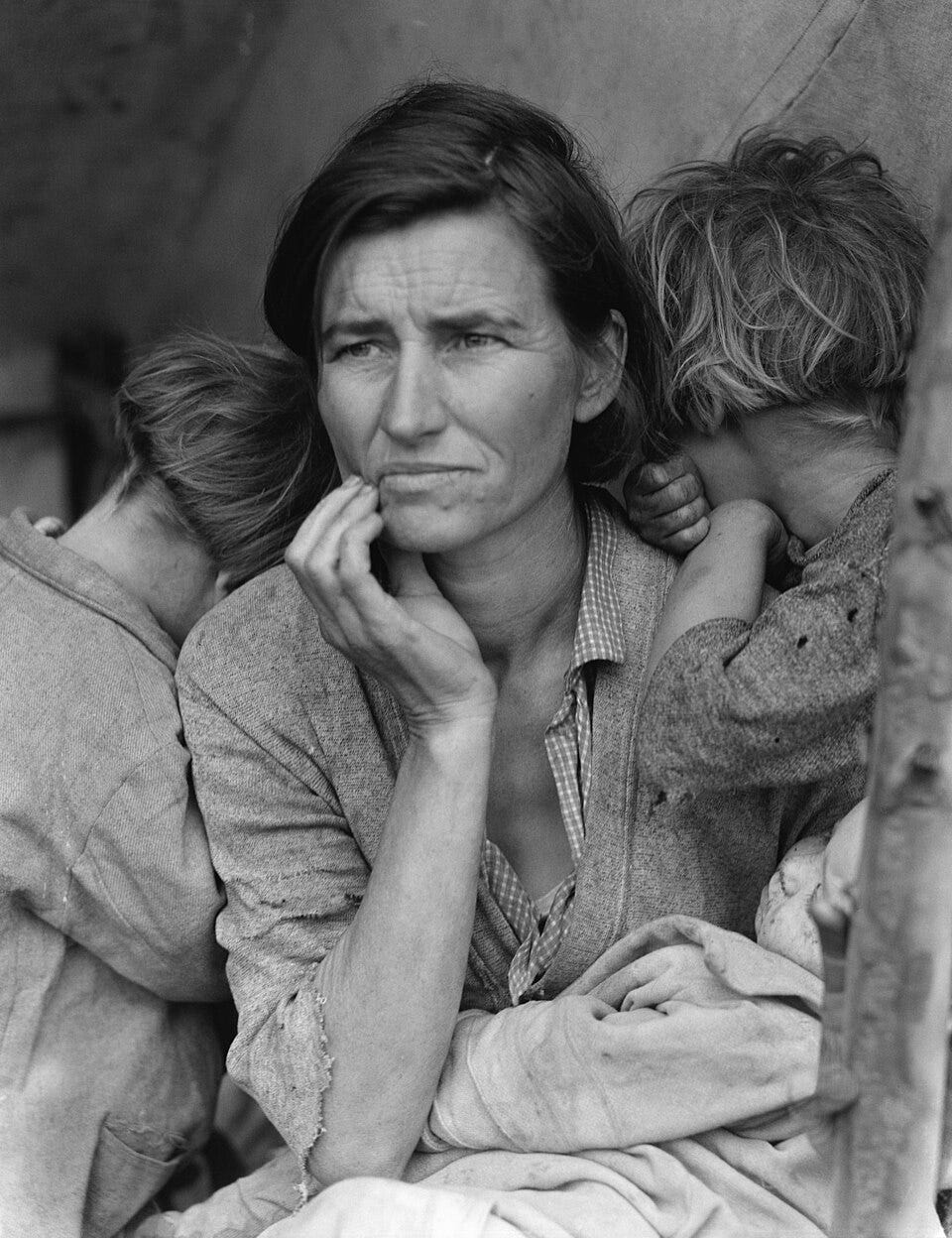
If "Pop Singer" introduces identity tension, "Jackie Brown" reveals the human cost underneath. Like Dorothea Lange's "Migrant Mother," it doesn't editorialize.
It documents.
Is this your meal, Jackie Brown?
Barely enough
I’ve seen people throw more than this out
Is this your home, Jackie Brown?
This three-room shack
With no runnin’ water and the bathroom out back
Is this your grave, Jackie Brown?
This little piece of limestone
That says another desperate man took himself out
Is this your dream, Jackie Brown
The anger recedes here, replaced by something slower and harder to name, a kind of existential drift.
Mellencamp undercuts the “Morning in America” brightness with a pointed song like “Country Gentleman.” Here, Reagan-era confidence gives way to wounded interiority, nationalism refracted through personal uncertainty.
Country gentleman, we see him on TV
Glad handing folks and chatting to the nation
We never knew what really to believe
Just word upon slogan with emotional connection
And in the papers all we’d ever read is
So and so big-shot signed his resignation
Now, country gentleman he wants us to believe
That he’s kind and honest with the best intentions
He ain’t a-gonna help no poor man
He ain’t a-gonna help no children
He ain’t a-gonna help no women
He’s just gonna help his rich friends
Mellencamp shifts from populist slogans to personal dislocation. The sound itself, raw and stripped down, mirrors economic bareness. Less anthemic. More claustrophobic. It feels like comedown music. Big Daddy shows how the system never fully collapsed; it hardened.
It settled.
It petrified.
“J.M.’s Question” captures the ideological residue of the decade. Mellencamp isn’t arguing policy; he’s interrogating its emotional logic. The distorted arithmetic and defensive posture point to a world where competition has replaced trust, and moral clarity gives way to calculation.
Well, what kind of world do we live in
When eleven and seven equals two, yeah?
What kind of world do we live in
When you do it to your buddy 'fore he does it to you?
Got to do it to your buddy 'fore he does it to you
Big Daddy doesn’t offer resolution. It offers recognition. The villains Mellencamp spent the decade confronting never fully disappear; they diffuse into institutions, into communities, into ordinary lives, including his own.
If Uh-Huh observed, Scarecrow indicted, and The Lonesome Jubilee endured, Big Daddy reckons. The questions are no longer about what went wrong, but about what responsibility looks like after the anger fades, when the systems remain, and the person in the mirror does too.
The Reagan era didn't end so much as it calcified. The rhetoric faded. The policies stayed. And so did the people Mellencamp had been writing about all decade, still working, still adjusting, still telling themselves the story that gets you through. Big Daddy doesn't argue with any of that. It just sits with them. Which, in its own way, is arguably the most radical thing John Mellencamp ever did.
I'll have to give this one a listen. I heard Uh-Huh and Scarecrow quite a bit but never Big Daddy. You've got me interested here