


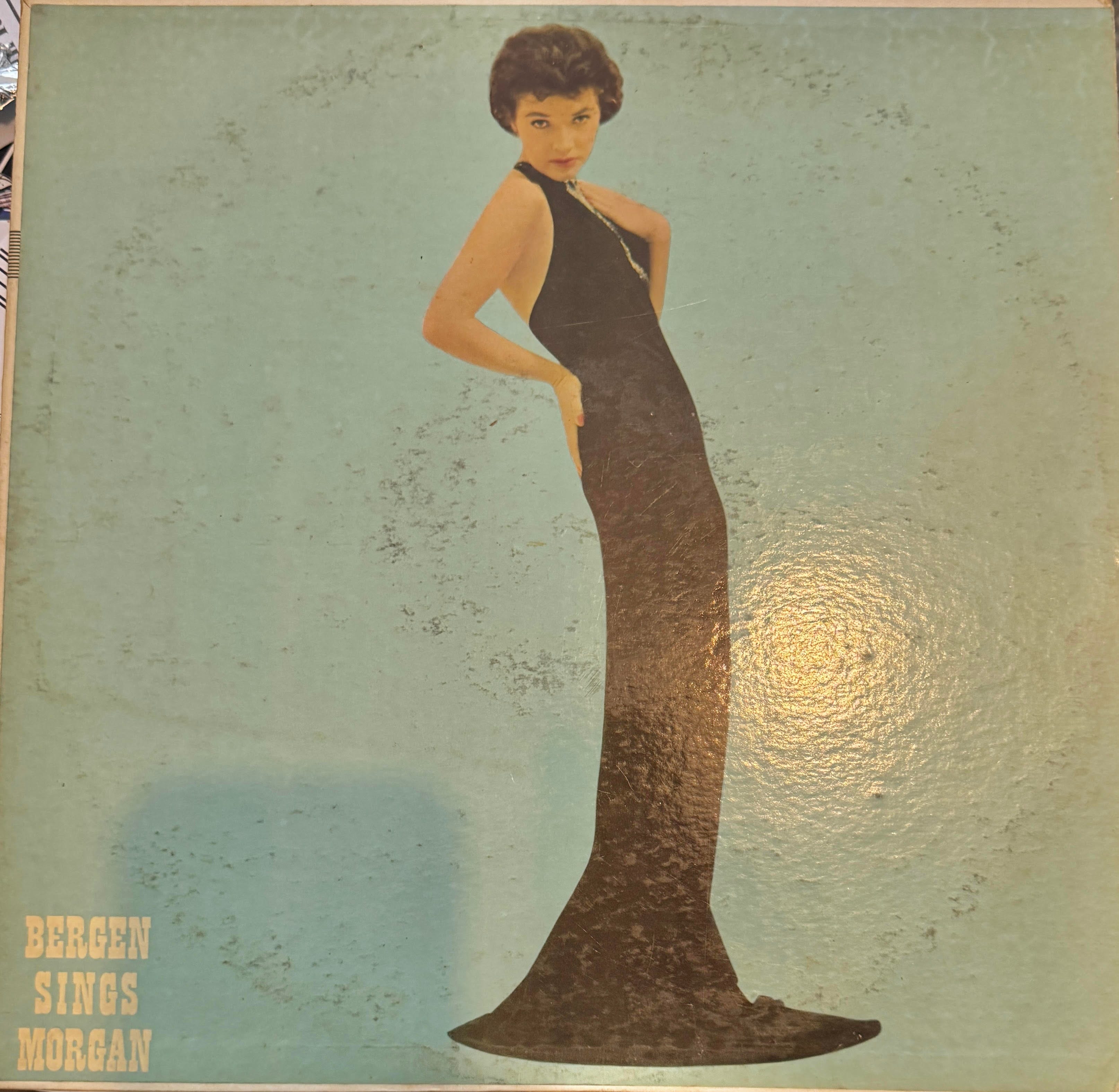
The 1957 album Bergen Sings Morgan finds multi-hyphenate Polly Bergen singing songs made famous by Helen Morgan. Not that I knew who either of them was, but that seductive look of Bergen on the cover told me exactly the type of music I would hear. I knew it would be a record full of torch songs. The type of music that would benefit from a martini and a cigarette, two of my parents’ favorite things. Bergen Sings Morgan is exactly the type of album I expected to find in my parents’ collection.
Helen Morgan, it turns out, was more or less exactly the kind of figure those songs suggest. A classic torch singer, she came up in Chicago clubs in the 1920s and made her name as Julie in Show Boat, which, even if musicals aren’t your thing, is one of those roles that actually matters.
Morgan’s life followed a familiar arc for singers of that era: nightclub success, Prohibition-era complications, and a reputation shaped as much by her drinking as by her voice. She opened her own club, had it shut down, reopened it under a different name, and eventually found herself indicted before being acquitted. The details almost feel beside the point. What matters is that her voice carried that life.
She died in 1941 at 41, of cirrhosis. Which, for a singer like Morgan, feels less like a biographical detail than part of the sound.
Polly Bergen, on the other hand, was something else entirely: a career professional. Actress, singer, Emmy winner (for playing Morgan, no less), Golden Globe nominee, businesswoman, and television presence. Later generations might recognize her from The Sopranos, where she played Fran Felstein, the fictional former mistress of Johnny Soprano. Overall, Bergen built a long, carefully managed, and quite varied career that extended well beyond this material.
That difference, between someone who lived the songs and someone who mastered them, is the tension that defines this record.
After a career that kept her busy well into her twilight years, Polly Bergen passed away from natural causes in 2014.
Two tracks from Morgan’s benchmark Show Boat are here, “Can’t Help Lovin’ Dat Man” and “Bill”. It’s said that when Morgan was alive, she owned “Can’t Help Lovin’ Dat Man” in the same way Judy Garland owns “Somewhere Over the Rainbow”. I’ll let you be the judge (click here).
In Bergen’s hands, the song becomes something else. The melancholy is still there, heightened, but now it’s controlled and smoothed out. Where Morgan’s version feels like it might come apart mid-line, Bergen’s never does.
That’s the tradeoff.
Bergen gives you a cleaner, more legible version of the song. But in doing so, she removes the sense that anything is at risk.
Helen Morgan is also known for her role in Sweet Adeline. Both “Don’t Ever Leave Me” and “Why Was I Born?”, from that musical, are featured on Bergen Sings Morgan. While Morgan was the originator of “Why Was I Born?”, the track would be performed by a who’s who of 20th-century music, including Billie Holiday, Lena Horne, Frank Sinatra, and Bob Dylan.
Bergen sings “Why Was I Born?” like she already knows the answer and has made peace with it. That’s the problem. The song isn’t supposed to be resolved. It’s meant to hover in uncertainty. Bergen steadies it, cleans it up, and in doing so, quietly removes the ache that gives the question weight.
Show tunes are not my jam, but I can appreciate a beautiful voice. Polly Bergen has a fine voice, one of those voices that feels less discovered than constructed. It’s controlled, shaped, and carefully crafted, like every note was considered before it leaves her mouth. There’s real skill in that, but it comes at a cost.
She doesn’t sound like she’s inside the song so much as presenting it. The phrasing is precise, the tone is warm, but there’s a slight remove, like she’s standing just outside the emotion rather than risking getting caught in it. You never get the sense that something might go wrong, and with torch songs, that’s the whole point.
Aside from these show tunes, the rest of the album is good. Bergen has a professional voice. Maybe too professional.
In the end, Bergen Sings Morgan feels less like a revival and more like a translation, which makes some sense. The songs are all here, intact and recognizable, but something essential has shifted in the process. What was once fragile and perhaps a little dangerous becomes composed, even elegant.
Maybe that’s inevitable. You can’t recreate a voice like Helen Morgan’s any more than you can recreate the life behind it. The best you can do is approximate it, shape it, and present it.
Which is exactly what Polly Bergen does.
And maybe that’s why this record ended up in my parents’ collection. It takes something messy and makes it listenable. Something volatile, and makes it safe.
It’s not quite what the songs were.
But it is what they became.
I fell completely in love with Polly Bergen watching her on To Tell The Truth, but this is the first time I've actually heard her sing.
As good as this is, The Party's Over is even better, a feel-bad album you can luxuriate in