


From the soft opening notes of “Angelika Suspended” through the bombast and brilliance of “Complicated,” Frank Orall and his music and dance collective Poi Dog Pondering take you on a sonic journey that has you feeling all the feels while keeping your feet tapping.
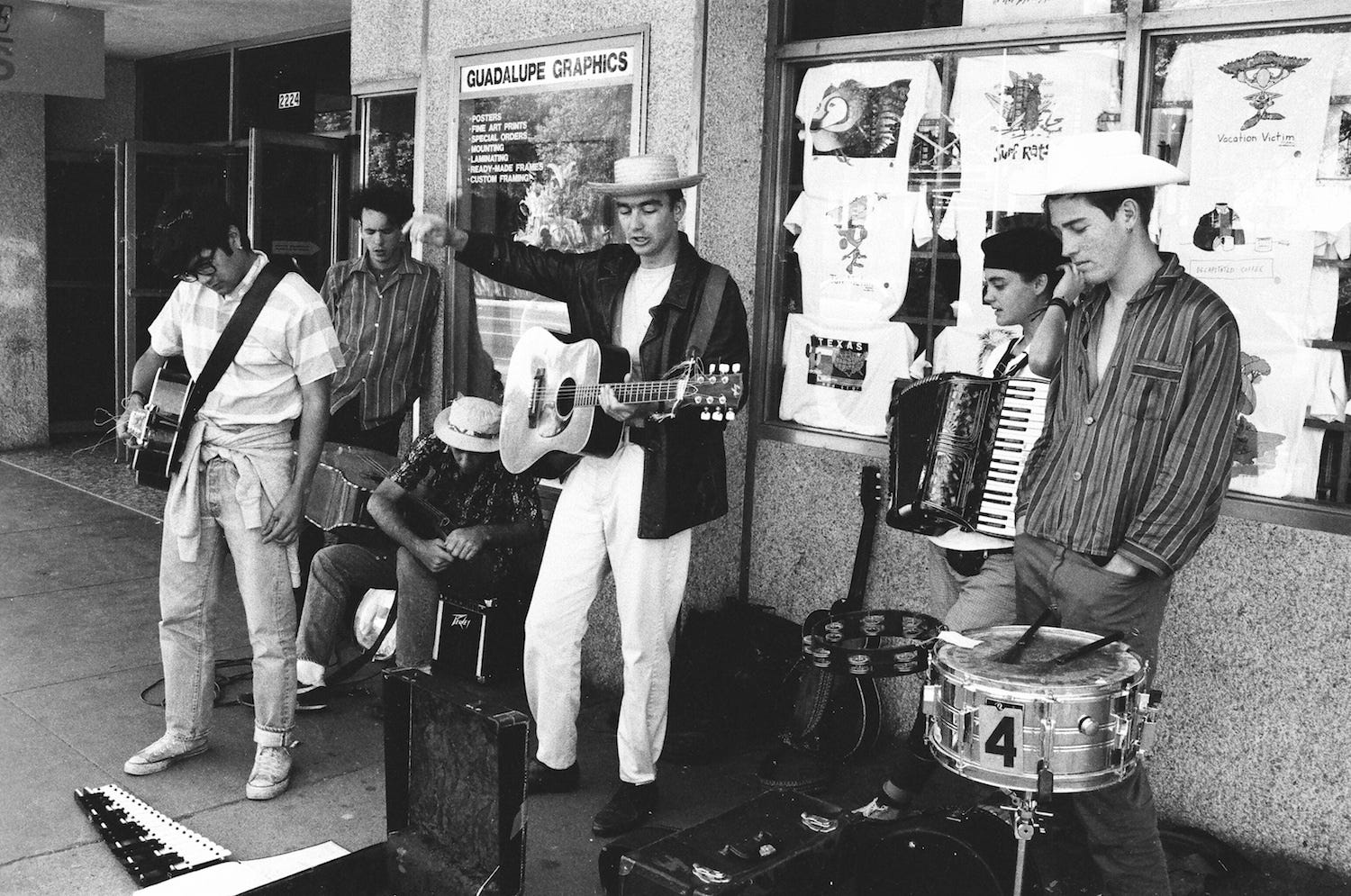
Captured in Chicago, the Hawaiian band’s adopted home, at the classic Vic Theater, Liquid White Light is the band at the peak of its powers.
Initially released in 1997, it covers the band’s first four albums: Poi Dog Pondering (1989), Wishing Like a Mountain and Thinking Like the Sea (1990), Volo Volo (1992), and Pomegranate (1995). The first three were released on Columbia Records but failed to gain much of a foothold, so they were let go. And then came Pomegranate, an indie release largely ignored outside of small circles.
Poi Dog Pondering is a band that’s hard to pinpoint. It didn’t help that these four albums were released during peak grunge. It would be literally impossible to mistake any of these records for “grunge.”
When you have about fourteen members, give or take, at any given moment. And the leader of the band is defined by his eclecticism and one member is the founding guitarist of The Slugs (Dag Juhlin). Another is a Grammy-nominated, Peabody award-winning violinist (Susan Voelz) who has played with a who’s who in music; in addition to a bevy of other talented band members, you’re bound to get a wide array of sounds — making Poi Dog part rock, part folk, part instrumental, part dance, part international, and so on.
It’s hard to label the Poi Dog Pondering sound as anything other than “its own thing.” Suffice it to say, those who knew of Poi Dog Pondering were, by and large, fans.
Liquid White Light is broken into a two-disc set, disc one a bit more mellow as it builds on the more subtle songs like “Sugarbush Cushman,” “Everybody’s Trying,” through to “Sandra At the Beach.”
Disc two is where all the action is. From the opening innuendo loaded “Diamonds and Buttermilk” to the Toni Morrison-infused “Shu Zulu Za,” to the leveling off of “Ta Bouche est Tabu” and “Collarbone” it’s the sound of a band hitting their grove.
“And the only thing that speaks the truth
is the eloquence of passing time
the spoken word is a jacket too tight” — Collarbone
It’s the triple punch combo of the last three songs, “Jack Ass Ginger,” “Platetectonic,” and “Complicated,” where the band reaches its apogee. The songs beg to be danced to and deserve to be heard at top volume.
What makes a live album work is that, somehow, the artist can project that live experience beyond the venue in which it was recorded. Of course, we all understand by now that adjustments are made after the initial recording, and that’s ok.
What would KISS Alive! be without overdubs?
Arguably, a live album becomes a right of passage if a band is around long enough. And they’re rarely more than obligatory. Hell, most of them are barely worth mentioning.
Only a few bands can capture that “essence,” those transcendent moments during a live show. It helps to have a band firing on all cylinders and make no mistake, Poi Dog Pondering is firing on all cylinders, and even a few extra ones on Liquid Light Heat.
Thanks for this... I remember Poi Dog Pondering well enough, including in concert where they were always good fun,and will see if this live album revives my interest in them. My recollection is that they were a difficult band to pigeonhole or categorize and as such it was no great surprise that COlumbia could not sell sufficient albums - though these were the days when majors at least gave it a decent try, with somewhat long-term investment. I do feel the need to point out that grunge really did not happen until 1992, after the initial impact of 'Smells Like Teen Spirit' and Nevermind led to the mass marketing of the sound. That may have proved a death knell for PDP with a major and explain the failure of their third album, but their first two - and I remember their release - came out in an entirely different market. Cheers!
Yeah... live albums are real hit or miss. This gets even more confused by the marketing campaigns by the record companies. I remember, "The Song Remains the Same" by Led Zepplin. It's a pretty average concert for that band actually. Nothing bad, but nothing great either. They'd had better. But career wise they'd (meaning Jimmy Page) decided it was the right moment for a live album and movie. And this particular concert had been filmed and had a good synced audio track. As an added bonus, Page's guitar playing was at its Zep best. So they settled on this one and built a movie around it. Zep being one if the biggest bands in the world at the time, it became a sub-cultural touchstone for a particular cohort of people. Mostly those between 14-24 or thereabouts, give or take... but looking back on it as I watch it today, it is a pretty average spectacle. Just as listening to old Kiss records now sounds like listening to a good garage band. Ahhh... the wisdom that comes with age and experience is a two edged sword.