


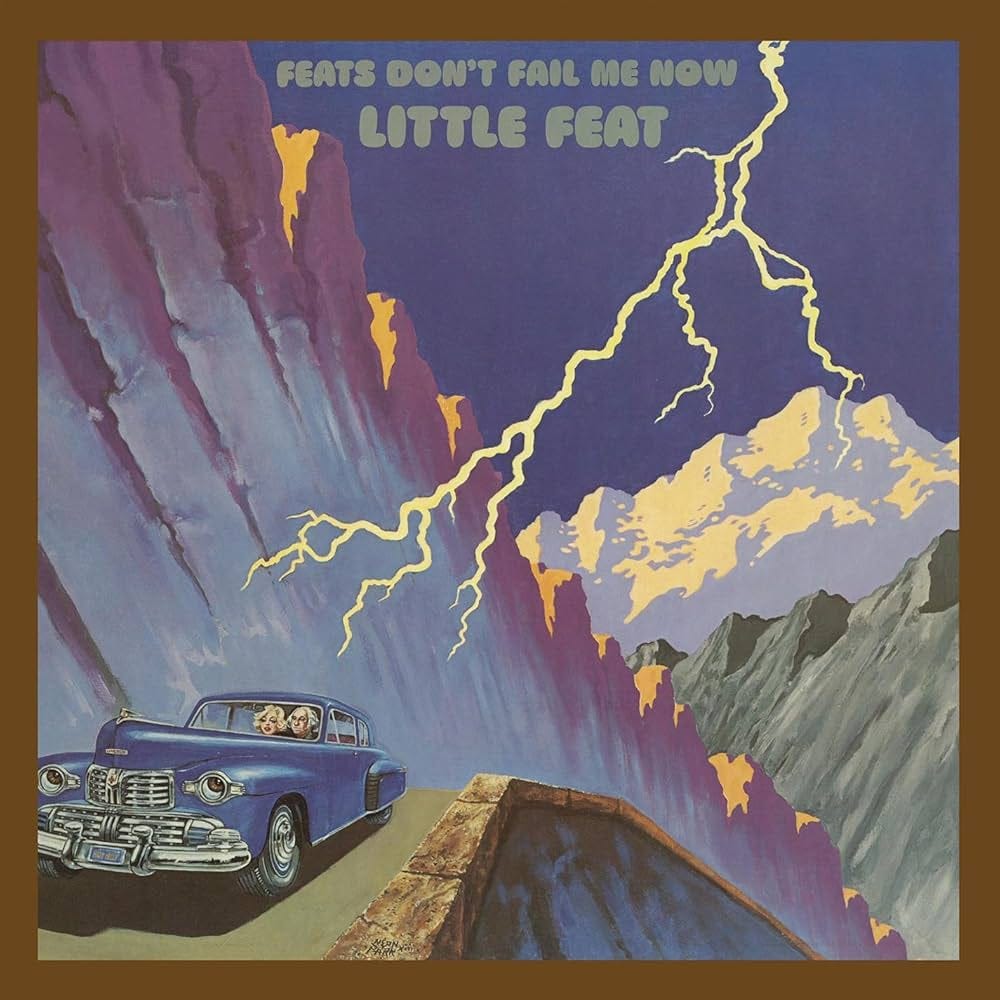
How Little Feat Feats Don’t Fail Me Now ended up in my parents’ record collection is beyond me. I associate peak Little Feat with weed and good times, both of which I don’t imagine my parents taking part in. Well, certainly not weed.
The only logical explanation might be that my mom (definitely my mom) bought it (for 6.99, the price tag is still on it), thinking it was a country album. My mother liked herself some country music. My father’s taste ran more akin to muzak.
Formed in 1969 after being kicked out of (or left, reports vary) Frank Zappa’s Mothers of Invention, Little Feat began with vocalist and guitarist Lowell George and keyboardist Bill Payne. The classic line-up of Little Feat was Lowell George - vocals, guitar; Bill Payne - backing vocals, keyboards; Paul Barrere - backing vocals, guitar; Kenny Gradney - bass; Richie Hayward - backing vocals, drums; and Sam Clayton - backing vocals, percussion.
Feats Don’t Fail Me Now is definitely not country music. The guitar sound is Bakersfield-adjacent, but it’s tough to pinpoint Little Feat. They’re not quite Southern rock in the vein of the Allman Brothers or Lynyrd Skynyrd, and they’re not necessarily known for improvisational jams like The Grateful Dead (this record’s “Cold Cold Cold/Triple Face Boogie” notwithstanding).
Even the internet has a hard time labeling them; some places call it “country funk,” and others call it “swamp rock.” I’ll call it good - a bit dated, but good.
This record sits right in the middle of the band’s classic run and captures Little Feat at the moment when their swampy funk, New Orleans R&B, and studio craft were fully locked in. Released in 1974, the record sits between Dixie Chicken and the band’s later live peak, Waiting for Columbus.
Mixing both swagger and exhaustion, the record opens with “Rock and Roll Doctor”, which straddles the fence between satire and autobiography. Sung by George, the song’s loose groove and hook highlight his pop craftsmanship.
“Spanish Moon” is arguably the album’s centerpiece. Lowell George’s songwriting wasn’t big on grand themes; his songs were observational, inhabited by bartenders, gamblers, and survivors. It’s almost anthropological, as sung by George with a half-drawl, half-smirk; it makes the “hookers and hustlers” believable.
Built around a slinky, funky groove, “Spanish Moon” sounds like a late-night walk through a shady area of New Orleans.
Without tipping into excess, the keyboards and horn arrangement help give this track a theatrical feel.
The writing here is artfully tight. As the primary songwriter, George builds songs around small, vivid details rather than big emotional statements. It could be a line of dialogue, or a street name; it’s those details that give his characters dimension without needing long explanations.
That’s why many Little Feat songs feel like short stories with something missing. You drop into a scene that clearly started before the song begins and will probably continue after it ends. George rarely resolves the narrative. Like the best movies, he lets you watch the characters, albeit for three minutes, and draw your own conclusions.
Feats Don’t Fail Me Now is the band’s fourth album and the one with what is arguably their most well-known song, “Oh Atlanta.” The song, written by and sung by keyboardist Bill Payne, stands in direct contrast to George’s songwriting style.
Unlike many Lowell George-penned Little Feat songs that drift through sweaty grooves and crooked characters, “Oh Atlanta” is startlingly straightforward. It’s a road song, part love letter, part homesick daydream, about a musician imagining a place that feels a little more hopeful than wherever he happens to be standing.
Musically, it’s one of the band’s most direct rockers. The rhythm section locks in while Bill Payne’s piano pushes the song forward like a barroom train engine. Compared with Lowell George’s more shadowy storytelling, Payne’s lyric is simple and openhearted. That simplicity may be exactly why the song has endured.
While the band’s most successful album is the live opus Waiting for Columbus, the 1974 Feats Don’t Fail Me Now remains their most successful studio album, peaking at #30 on the Billboard album chart and being certified gold (500,000 units).
You can tell the album is from the mid-70s by the artwork. At first, I thought it was the work of R. Crumb, but the album cover art is actually by Neon Park (Martin Muller), best known for designing the covers of every Little Feat album except their self-titled debut. Park also designed artwork for Frank Zappa, David Bowie, Dr. John, and the Beach Boys.
On this album, the band often sounds relaxed, almost barroom-casual, but beneath that looseness lies tight control. For a band from Los Angeles, the songs lean more toward New Orleans funk than blues-rock, with Payne’s piano and organ filling the gaps and driving the groove forward.
Feats Don’t Fail Me Now is music that feels humid, deceptively slow-moving, like a summer afternoon in a non-air-conditioned New Orleans bar.
While one wouldn’t necessarily categorize Little Feat as a “political” band, the album was released in August 1974, just as public trust in government was collapsing and Richard Nixon was resigning. The album must’ve served as a swampy reprieve from all of that.
As good as Feats Don’t Fail Me Now is, the real mystery remains how it landed in my parents’ record collection in the first place.
Some questions never get answered. This one will have to remain one of life’s little crate-digging mysteries.
I bought this album when it came out based on the cover alone. No idea who they were. I became an instant fan and have been since. This record is an American music classic. Great write up. Hopefully it will move those who don't know the magic of LF to discover their albums, and definitely starting with this.
I have that cover, signed by Park, framed in my home library. And I've had a "HOY-HOY" license plate on my '72 Triumph since '75. That's how much I love this album. Has it been forgotten? Probably so. Much like Neon Park, who has not had a proper gallery retrospective similar to those for Rick Griffin or R Crumb. He is slipping into the past like a lot of the great music from the mid-70s. You'd be hard pressed to hear Little Feat or early Tom Waits on your local classic rock station.