


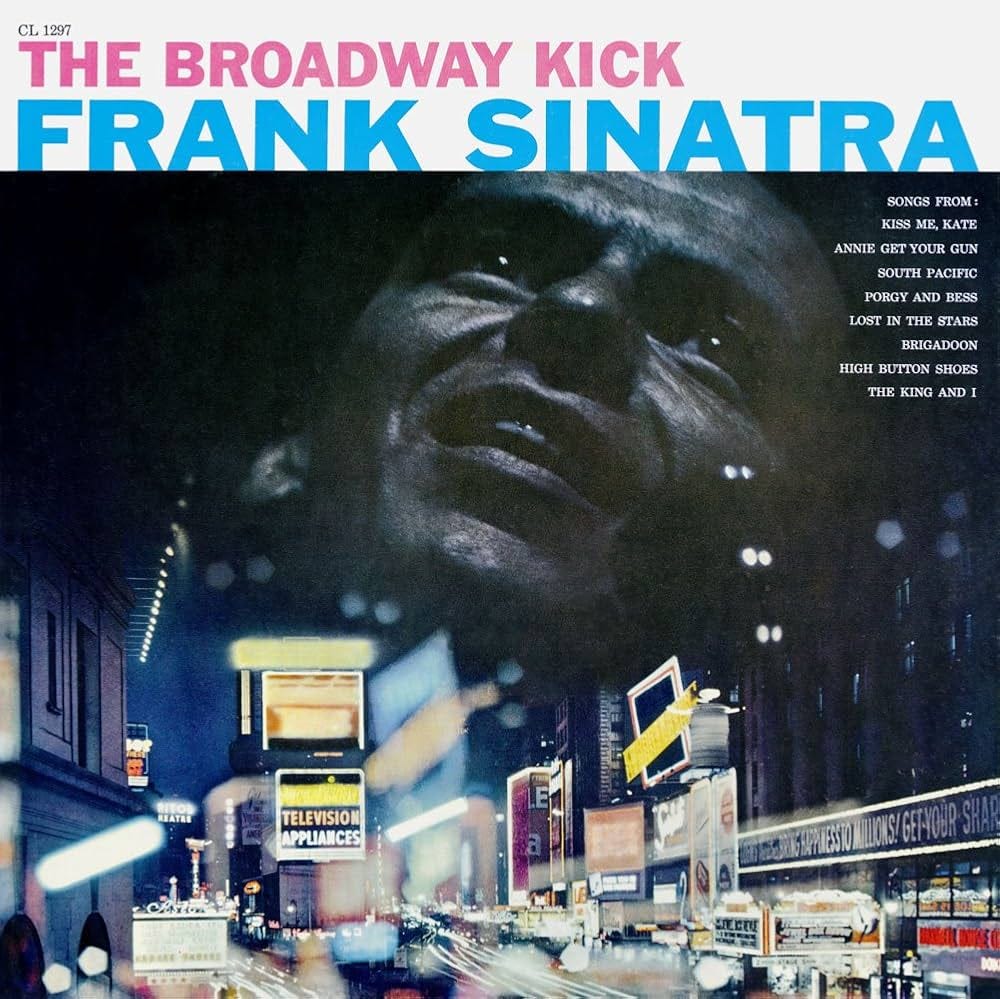
Ah-ha, I have finally unearthed music I think my father must’ve liked - Frank Sinatra, which is no surprise. While the number of Sinatra albums isn’t surprising given my parents’ demographic, it's still interesting to me. A total of 12 Sinatra albums, far and away the most by any artist they had.
What drew me to The Broadway Kick is that there are two copies of it. In my fantasy retelling, my parents bonded over this album while dating, and neither could part with their copy when they married. But knowing my parents, that’s probably way too romantic a read. I’m certain that the story is much more benign than that, but I should say that both of these albums have seen a lot of travel over the years, so maybe there is something there. I think I’ll stick with my more romantic interpretation.
The Broadway Kick is one of four compilation albums of Sinatra’s put out by Columbia Records in 1959 (and two albums put out by Capitol Records). Man, they released a lot of albums back then. I mean, looking at Sinatra’s album list is like trying to count the grains of sand on the beach.
That being said, no matter what era you look him up in, Sinatra won’t be defined by one album.
The Broadway Kick feels less like a definitive statement and more like a transitional document. It sits in that middle period of his career, when he’s no longer the scrappy saloon singer, but not yet the elder statesman he would become in time. What you get on this record is a performer engaging with the Broadway canon.
Broadway recordings have never been my natural territory, but this one pulls me in despite myself. There's something in the tension between Sinatra and the material that makes it more interesting than you might think.
Sinatra, who made a career out of making intimacy sound effortless, sounds like he’s keeping this material at arm’s length. These aren’t songs that belong to him in the way that songs like “Luck Be A Lady” did. Still, when it clicks, he bends the song to his will, turning theatrical bravado into something more personal.
The track list here pulls from Annie Get Your Gun, South Pacific, Kiss Me Kate, among others, and even though he sounds like he’s keeping everything at a distance, Sinatra handles most of it with his usual authority. “Some Enchanted Evening” is exactly what you’d expect, which is to say, it’s excellent. “Lost in the Stars” is quieter and more interesting; Frank sounds like he actually means it, which on this record, isn't always a given.
The problem, such as it is, is that these songs weren’t written for him. “There’s No Business Like Show Business” will forever be an Ethel Merman number, and Frank sounds faintly uncomfortable here, like a man wearing someone else’s suit. He’s too cool for the material… and the material knows it.
“They Say It’s Wonderful” is a gentle Irving Berlin number and more in Sinatra’s wheelhouse. He sings it delicately, and it shows. “Why Can’t You Behave” is a Cole Porter song from Kiss Me Kate, and Porter and Sinatra were a natural pairing.
“I Whistle A Happy Tune” is the odd one out. It’s a Rodgers and Hammerstein number from The King and I, originally sung by a woman to comfort a child. Sinatra gets through it, but you can almost hear him wondering how he got here.
The two genuine highlights here are buried. “There But For You Go I” from Brigadoon is a gorgeous ballad that Frank treats with the care it deserves. He’s understated, warm, and completely in control of the material. And “Bali Ha’i” from South Pacific is a Polynesian-flavored tune from Rodgers and Hammerstein, complete with steel guitar. Sinatra wraps it with a high note that reminds you, in case you’d forgotten, exactly who you’re listening to.
What saves the album is what always saves every mediocre Sinatra record, his voice. Even when the song isn’t quite right, the instrument is. You can put Frank Sinatra on any ill-conceived song and walk away with something worth hearing.
The arrangements lean polished, even grand, but they rarely overwhelm, as if anything could. If anything, they underscore the central tension of the record: Sinatra as interpreter versus Sinatra as institution. It’s not his most essential album, but it’s revealing. You can hear him negotiating his place, and that alone makes it worth sitting with.