


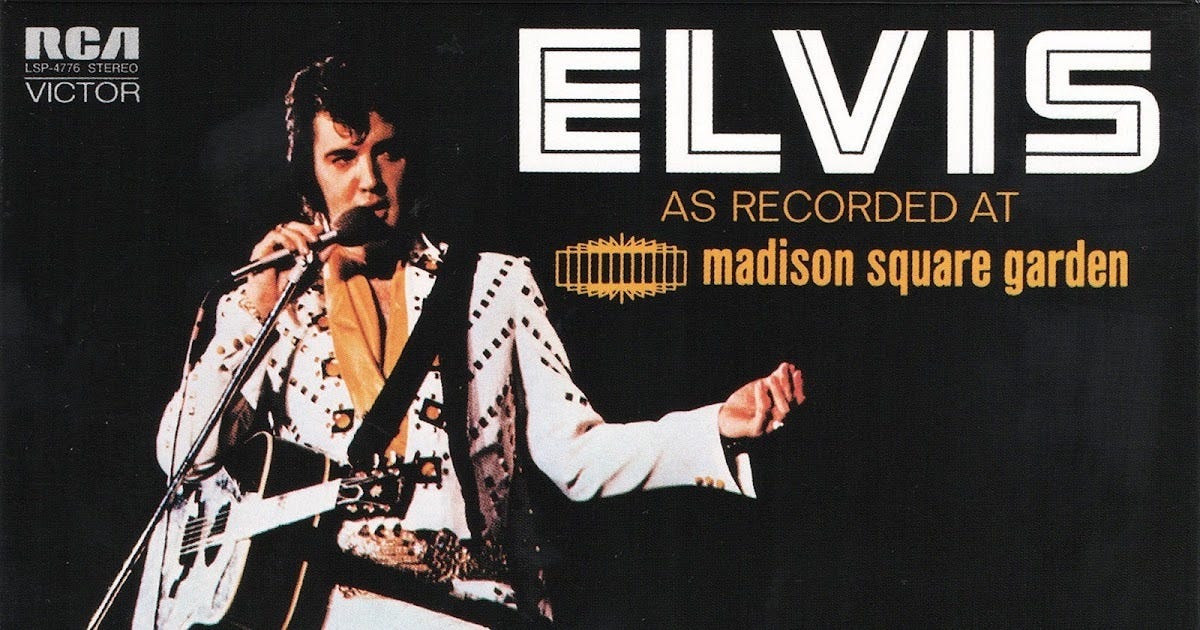
I inherited my parents’ record collection, and much to my chagrin, it’s filled with a fair amount of bupkis. My parents, to put it gently, had crap taste. There are a lot of showtunes. A lot of easy listening. A lot of things I’ve never heard of. Imagine the record collection of Midwest older/nerdy boomers, and you’ll have an idea.
But every once in a while, buried among the dreck, there’s something worth pulling out and exploring. In this case, it was Elvis: As Recorded at Madison Square Garden.
After reading an IG post from my friend Rob Janicke about Reinventing Elvis - the 68 Comeback, I decided to drop the needle on this album. It helped that I’m currently knee-deep in There Was Nothing You Could Do by Steven Hyden, where the record shows up as a useful benchmark.
Hyden uses the Madison Square Garden concert and subsequent album as an analogy for the kind of cultural saturation Bruce Springsteen would reach during the Born in the U.S.A. era.
That said, my relationship with Elvis Presley is mostly theoretical. I’ve always known the legend and liked a handful of the songs, but until inheriting this record, I had never actually owned an Elvis album.
The concerts (afternoon and evening) themselves took place on June 10, 1972. Elvis: As Recorded at Madison Square Garden documents the evening performance; the afternoon show wouldn’t surface until 1997’s An Afternoon in the Garden.
By 1972, rock had moved on to singer-songwriters and album statements, but Elvis was doing something different, turning his own past into the show. Either way, the record feels less like a conventional live album and more like a high-speed revue, one hit tumbling into another, a career condensed into fifty-two minutes.
The first thing you notice is the pace.
Everything moves fast.
Like, weirdly fast.
In a 2009 BBC documentary, Elvis’s longtime drummer, Ronnie Tutt, suggested that Colonel Tom Parker had the mixes sped up to fit more songs on the record, increasing royalties. It makes for a great story, and given what little I know about the Colonel, it’s not hard to fathom.
But apparently it’s not true.
You don’t have to wait long to hear that speed as the band explodes into “That’s All Right,” and the entire show is off and running. The breakneck pace may start you wondering how a man who once received a badge from Richard Nixon as a “Federal Agent at Large” in the war on drugs was keeping up with the tempo.
Nonetheless, Elvis himself is in top form. Still riding the momentum of his 1968 comeback, he sounds like he’s genuinely enjoying himself. The cynicism that seems to define the later years, an impression picked up through the cultural ether, hasn’t set in yet. Elvis: As Recorded at Madison Square Garden falls squarely in that window when Elvis was cool again.
Backed by his TCB (Taking Care of Business) Band, firing on all cylinders, Presley visits all the hits. Clearly, this is the precursor to late-stage Elvis in Las Vegas. The Elvis no one seems to like. What the record captures, more than anything, is Elvis the entertainer and less the revolutionary force he once was, and more the ringmaster of his own legend.
Elvis wasn’t much of a songwriter, so what you get throughout his career are interpretations. This record is no different. After thundering in with “That’s All Right,” he shifts into “Proud Mary,” which he makes his own, even if it still pales in comparison to Ike and Tina Turner’s version.
One miss is “You Don’t Have to Say You Love Me.” This is a classic torch song, but as it is here, it’s pop. Not to say it’s bad, it’s just lacking the sadness of Dusty Springfield’s original or Shelby Lynne’s later interpretation.
I would challenge anyone to pistols at dawn if they speak ill of “Polk Salad Annie.”
Moments like that are why Elvis: As Recorded at Madison Square Garden works: even when Elvis isn’t reinventing anything, he’s still the most compelling performer in the room, and sometimes that’s more than enough.
My mother was so obsessed with Elvis's death that she wept for three days. I heard his music so much that he was like a sibling.
Round about my 8th or 9th. Christmas, dad gave my and mybtwo siblings a portable cassette player along with two tapes, John Cash and Elvis Greatest Hits, one of the most beloved and impactful gifts Ive ever received. still have the tapes Nd occasionally listen to them nearly six decades later. My appreciation for Elvis was recently reignited by EPIC (Elvis Presley in Concert) seen on Imax, more significantly, thrilling my wife who had considered him a joke until then. Will have to give the Madison SG a listen now and look forward to it!
While Im at it, i have to say there was no dreck in my parents limited collection. I still listen to their copies of Odetta, Lightening Hopkins, Weavers, Otis Spahn, Woodie Guthrie, Huddie Ledbetter, Oscar Brand, Bob Gibson etc on a regular basis. Gibson and Camo Live remain a favorite of all time.